The Road to Salvation
There are moments in life when one would be suddenly devoured by loneliness, inexplicable yet undeniable, for reasons beyond the surface of my breathing consciousness; and the afternoon before sunset on January 28th was just such a moment. I kept dates for marking significance if any, yet inevitably move on forgetting them since after all there lies no inherent meaningfulness in the figures of dates and times. What does lie in it is the tender indifference—the sense that dates and times exist independently of the events that have happened, hence is the only appropriate title for them rather than a grossly glossed over description, like “sadness” or “a happy day.”
The street view was in its usual monotony reflected upon the windows of the circulating shuttle, but amid this stood distinctly, shouting at me, was the ivory-white wall fractured into pieces by the waning afternoon sun—a Peircean icon that resembled some places I'd been to, some walls I'd seen before but not in this country. It was then I realized, more explicit than most of the time, that my reality had already transformed to another phase that I'd not prepared to step into. I stared at it mindlessly until certain sacred fragments flickered in the wall's surface, emerging from my subconscious association—it was an uncontaminated surface distilled and rinsed in the fountain of sunlight. It was as I had often imagined being in the ideal place: Such wall could, and should, exist only in the ideal place, the place of salvation I'd searched for long, as ghosts are said to do.
I had long been captivated by the notion of salvation, strangely so, for initially neither myself nor anyone around me had any religious grounding. I recalled it was in my middle school years when I was introduced to Tiesheng Shi, a writer of profound theological sensibility who was one of the most revered Chinese novelists of the 20th century, and his The Temple of Earth and I, which was again one of the most renowned Chinese prose essays of the 20th century. Thus began my pilgrimage across half the country alone to the Temple of Earth—my first attempt at searching for the road to salvation, spurred by the psychological complex that a typical teenager would have when they started pondering on meaningfulness of every existence. The walls of the Temple of Earth—to my disappointment and disillusionment—were nothing close to the ones in his autobiographical pictures.
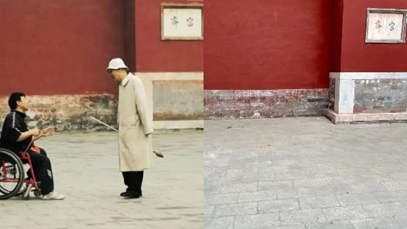 Shi was a man in wheelchair for 38 years.
The wall I had just seen during my daily commute was not my wall, I said to myself as I managed to assemble traces of thoughts amidst the roaring engine and the squeaks and creaks of the shuttle, just as this was not my place. Neither was the wall I'd seen at the Temple of Earth—such possibility collapsed the moment I arrived there. It's of no meaning even if I were to purchase a plane ticket that arrives back tomorrow and spend every minute searching for it until the exact location of it is found again.
Over time, I was very much convinced by Shi's nihilistic tendencies, along with many other absurdist literature or philosophers that followed in my path. Yet I'd never truly discarded the subconscious yearning for a form of salvation; I oftentimes persuade myself that I'm already walking toward it. There was a time I used to thought I would find it in my future at Hopkins, as I strolled down the routes with which I'm so familiar at 4am in the hush of midnight. I was almost certain that a future awaits me ahead and I shall be patient until this future occurs to me inevitably and rather smoothly, just a couple of months beyond; and that became my only real thing to do from January to August. Yet the door to such ideal place was shut as I arrived here, or rather, it had never been open to begin with. “Open it now and I shall find no enchanted garden.”
Then I recalled an instance in July, another of my habitual 4am, and the light touch of drizzles softly brushed against me. I remained unmoved. There was no part of me even remotely distressed. I was again zoning into the alternate dimension I constructed for long, in which there was no difference between whether raining or not, in which there was no difference between living and dying. I threw myself heedlessly into the rain for I know that in but a short while a warm shower awaits at home, just like how a kid labors through tedious exam revisions for they know a long holiday awaits beyond the toil, just like how newlyweds save passionately for the certainty that each passing day draws their long-dreamed-of honeymoon ever closer, just like how the ailing swallow down pills determinedly for their fragile hope of having another tomorrow to strut and fret a bit more on life's stage. It occurred to me then after all we are all travelers clinging to the faint flickering light upon the horizon, an illusion so conspicuous that we have convinced ourselves of its existence; even though awaits ahead is a home in disarray, a holiday consumed by tutors and lessons, an adventure lost in the faceless crowds, a life prolonged only to languish on the edge of another breath. The eternal salvation is neither the fleeting present nor the certainty of death, but the ceaseless yearning and the fervent prayers. Shi once alluded to the reincarnation idea: ‘I do not know if I look like a child or an old man or a lover in the middle of their youth and passion—I might be all of them', and I believed I did eventually grasp the nuances in his lines at that moment. I noticed I was too praying, like that kid or the newlyweds or the ailing—I'm indeed all of them, praying under the Wailing Wall of Jerusalem, possessing the same devoutness to different faiths of their own. Every other being in some form or another carries the reincarnation of this spirit, whether we interpret this literally or metaphorically; and life emerges and deceases, over and over and over again.
Have I changed since then? I envisioned myself constantly asking the same question over the course of my life. The shuttle had long been gone since passed the wall, or maybe I hadn't truly seen it at all; it was but only another illusion of salvation I sought, like the countless walls I'd walked pass in my midnight walks. I've seen many walls like this, I said to myself, and there will be many more. There are many walls like this on the road to salvation—it lays all about me, and I need not to take any findings. “I have left behind illusion, I said to myself; henceforth, I now live in a world of three dimensions, with the aid of my five senses.”
The marble wall inscribed with “Johns Hopkins University” was coming into sight.